
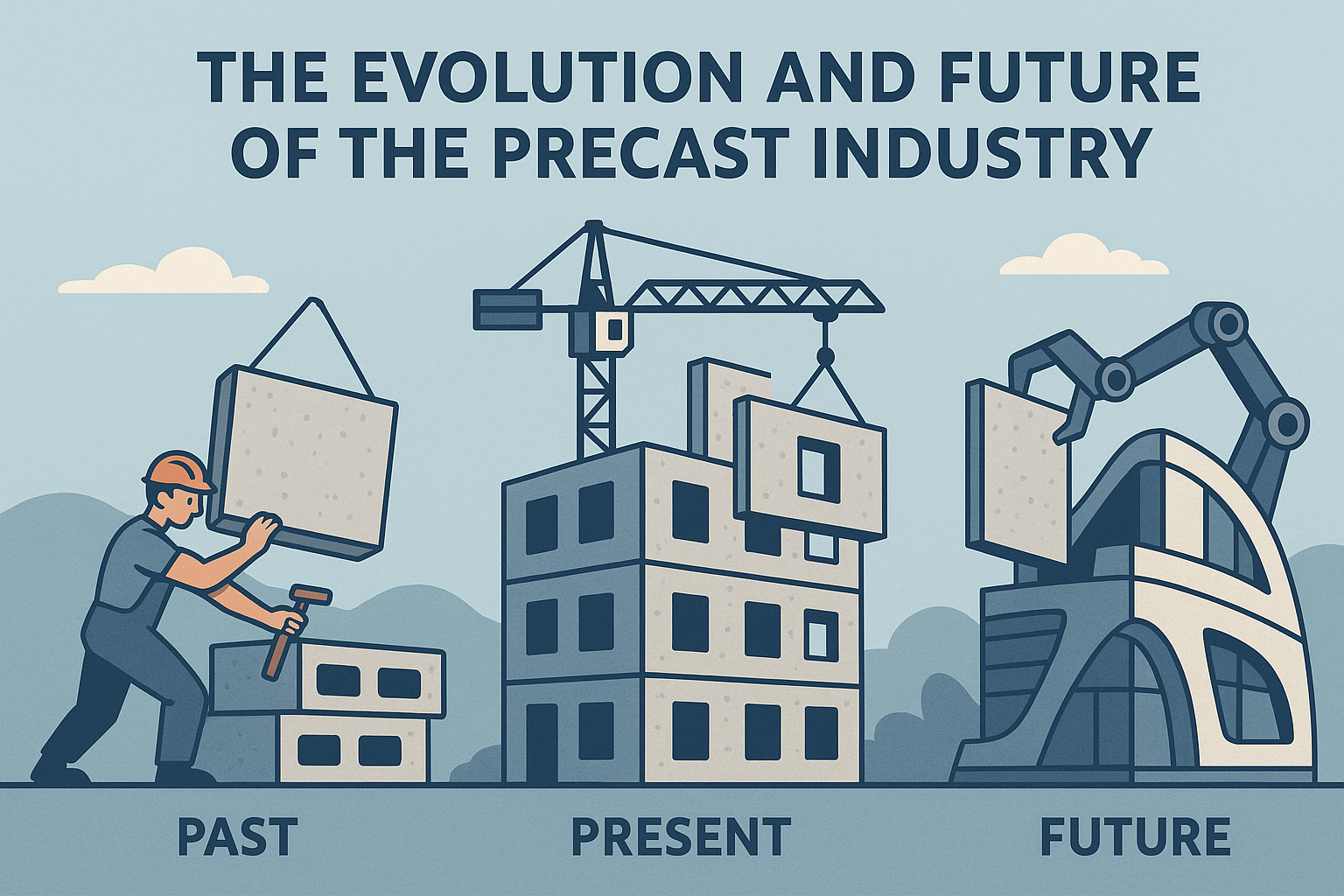
The precast concrete industry stands at a technological crossroads, evolving from traditional manufacturing methods to AI-powered digital ecosystems. With the global market projected to grow by $21.8 billion from 2025 to 2029, this transformation represents one of construction's most significant technological leaps.
Historical Development
The precast concrete industry traces its roots back to the early 20th century, when the first standardized precast elements were developed for mass housing projects. Initially, the industry focused on basic structural components such as beams, columns, and wall panels, primarily for utilitarian purposes.
Key Milestones in Precast Evolution
Technological Advancements
Manufacturing Innovations
Modern precast manufacturing has embraced cutting-edge technologies that have revolutionized production capabilities and quality standards:
- Automated Production Lines: Computer-controlled manufacturing processes ensure consistent quality and reduced human error
- Advanced Formwork Systems: Reusable, precision-engineered formwork enables complex geometries and superior surface finishes
- Smart Curing Systems: Automated temperature and humidity control optimize concrete strength development
- Quality Monitoring: Real-time sensors and monitoring systems track production parameters and product quality
Design and Engineering Capabilities
The integration of advanced design tools and engineering software has expanded the possibilities for precast applications:
- 3D Modeling and BIM: Comprehensive digital modeling enables precise coordination and clash detection
- Finite Element Analysis: Advanced structural analysis ensures optimal performance and safety
- Parametric Design: Algorithm-driven design processes enable mass customization
- Virtual Reality: Immersive design review and coordination tools enhance project visualization
Current Industry Statistics (2024-2025)
Global Market Size: $156.2 billion (2024)
Projected Growth: $21.8 billion additional growth (2025-2029)
Annual Growth Rate: 6.2% CAGR (2025-2029)
Technology Investment: $2.1 billion in BIM, IoT, and automation systems
Sustainability Impact: 25% less embodied carbon vs cast-in-place concrete
Digital Twin Technology Revolution
Digital twin technology has emerged as the cornerstone of modern precast manufacturing, creating virtual replicas of physical production processes that enable real-time optimization and predictive analytics:
- Real-time Process Optimization: Continuous monitoring and adjustment of concrete mixing, curing, and quality control parameters
- Predictive Maintenance: AI-driven analysis prevents equipment failures and optimizes production schedules
- Quality Assurance: Digital monitoring ensures consistent product specifications and early defect detection
- Resource Efficiency: Optimized material usage reduces waste by up to 25% in leading facilities
Leading manufacturers like Spanbeton in the Netherlands have implemented comprehensive digital twin systems, resulting in 30% faster production cycles and 40% reduction in quality defects through integrated IoT sensors monitoring concrete temperature, humidity, and strength development in real-time.
Modern Applications and Capabilities
Architectural Precast
Today's precast industry offers unprecedented architectural flexibility, enabling the creation of complex, visually striking structures:
- Custom facade panels with intricate textures and patterns
- Curved and organic forms that were previously impossible
- Integrated building systems combining structure, insulation, and finishes
- Large-scale architectural elements for iconic buildings
Structural Innovation
Advanced structural precast systems provide superior performance and construction efficiency:
- High-strength concrete mixes with compressive strengths exceeding 100 MPa
- Hybrid systems combining precast and post-tensioned elements
- Seismic-resistant connections and detailing
- Modular construction systems for rapid assembly
Regional Market Dynamics and Growth Patterns
The global precast market shows distinct regional characteristics and growth patterns:
Asia-Pacific Leadership (45% Market Share)
- Massive infrastructure investments in China, India, and Southeast Asia driving demand
- Singapore's public housing program showcasing 80% precast adoption in new residential construction
- Advanced manufacturing hubs in Japan and South Korea leading technology integration
- Expected 8.1% CAGR through 2029, highest globally
European Innovation Hub
- Nordic countries leading in energy-efficient precast solutions with integrated insulation systems
- Germany and Netherlands driving automation and digital integration initiatives
- Strict environmental regulations spurring development of carbon-neutral concrete mixes
- Focus on circular economy principles and end-of-life recyclability
North American Growth Market
- 25% annual growth in precast parking structures and warehouse construction
- Commercial and industrial sectors driving standardization efforts
- Investment in automated production facilities to address labor shortages
- Focus on cost optimization and delivery time reduction
Automation and Robotics Revolution
The precast industry is witnessing unprecedented automation adoption, transforming traditional production methods:
- Robotic Reinforcement Placement: Automated rebar positioning systems achieve ±2mm accuracy while reducing labor requirements by 50%
- AI-Powered Quality Control: Computer vision systems detect surface defects, dimensional variations, and finish quality in real-time
- Automated Concrete Distribution: Robotic concrete placement ensures uniform distribution and optimal compaction across complex geometries
- Smart Curing Systems: IoT-enabled curing chambers optimize temperature and humidity profiles for maximum strength development
Future Trends and Opportunities
Sustainability and Green Building
The precast industry is at the forefront of sustainable construction practices:
- Carbon-neutral concrete mixes using alternative binders and aggregates
- Energy-efficient precast systems with integrated insulation
- Circular economy principles in material sourcing and waste management
- Life cycle assessment and environmental product declarations
Digital Transformation
The integration of digital technologies continues to reshape the industry:
- Internet of Things (IoT) sensors for structural health monitoring
- Artificial intelligence for predictive maintenance and quality control
- Augmented reality for installation guidance and quality assurance
- Blockchain technology for supply chain transparency and certification
Modular and Offsite Construction
The trend toward modular construction presents significant opportunities:
- Complete building modules manufactured offsite
- Plug-and-play systems for rapid deployment
- Standardized components for mass customization
- Reduced construction time and improved quality control
Challenges and Solutions
Current Challenges
Despite significant progress, the industry faces several challenges:
- Skilled labor shortage in specialized precast operations
- High initial investment requirements for advanced manufacturing facilities
- Transportation and logistics constraints for large precast elements
- Market perception and education about precast capabilities
Innovative Solutions
The industry is developing innovative solutions to address these challenges:
- Robotics and automation to address labor shortages
- Modular manufacturing facilities for reduced capital requirements
- Advanced logistics and transportation systems
- Comprehensive education and training programs
Conclusion
The precast concrete industry has evolved from a simple, utilitarian construction method to a sophisticated, technology-driven sector that offers unparalleled opportunities for innovation and growth. As the industry continues to embrace digital transformation, sustainability, and advanced manufacturing technologies, it is well-positioned to meet the challenges of modern construction while delivering superior quality, efficiency, and environmental performance.
The future of precast construction lies in its ability to adapt to changing market demands, integrate emerging technologies, and provide sustainable solutions that address the complex challenges of modern building design and construction. With continued investment in research, development, and innovation, the precast industry will remain at the forefront of construction technology and continue to shape the built environment for generations to come.
Comments
Loading comments...
Leave a Comment